
Direct answer
Future of AI Governance matters when technology must produce measurable operational improvement rather than cosmetic change. For organizations building ai governance capability, the practical priority is oversight, auditability, risk control and responsible automation, supported by governance, integration discipline, monitoring and clear operating metrics.
What it means in practice
The challenge for most organizations is not buying another tool. The challenge is building a controlled operating layer where processes, systems, people and data move together. DSANTOS approaches this as infrastructure: define the operating objective, connect the right systems, expose the right metrics and keep every automated action visible.
Business impact
A well-designed ai governance initiative should improve execution speed, reduce avoidable manual work, strengthen accountability and make operational movement easier to monitor. The result should be measured through cycle time, error rates, service availability, cost movement and decision latency.
Implementation approach
- Map the workflow and identify the highest-friction handoffs.
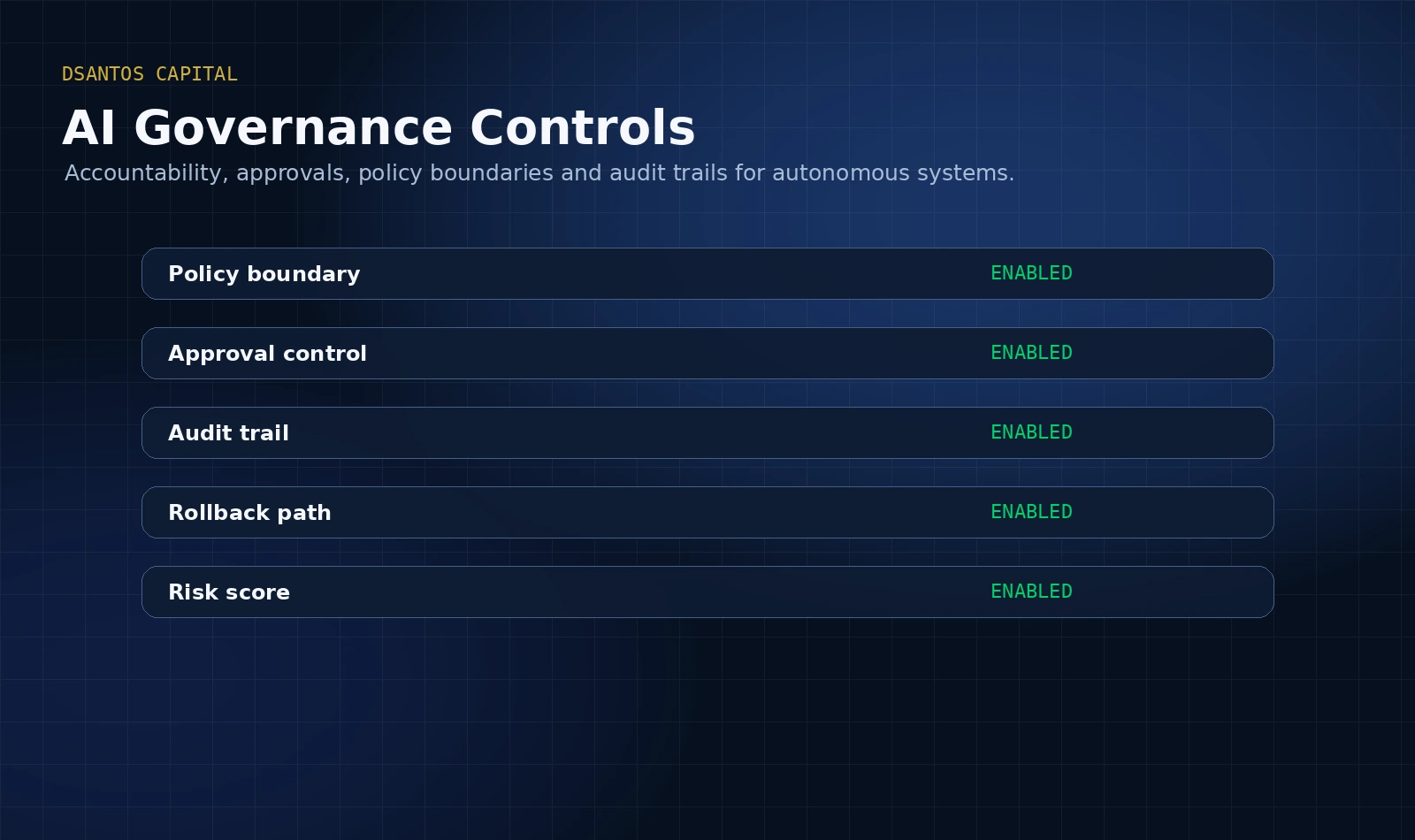
- Define approval points, audit requirements and rollback paths.
- Integrate with existing systems before replacing core infrastructure.
- Measure results through dashboards, logs and operational reports.
- Scale only after the pilot proves measurable value.
DSANTOS perspective
DSANTOS CAPITAL treats ai governance as an execution capability, not a decorative technology layer. The goal is to help organizations build systems that are observable, governed and practical enough to operate under real business conditions.
Why does this matter?
It matters because execution problems become expensive when teams lack visibility, ownership and reliable system controls. This capability helps convert operational activity into measurable action.
What should leadership measure first?
Leadership should measure time saved, error reduction, decision speed, uptime movement, cost movement and the number of manual handoffs removed.
Does implementation require replacing existing systems?
Not necessarily. A disciplined implementation usually integrates with current systems first, then replaces weak components only when the business case is clear.
What is the main implementation risk?
The main risk is automating an unclear workflow without governance, monitoring, rollback procedures or human approval where approval is required.
How should a business begin?
Start with one controlled workflow, define success metrics, establish audit trails, assign ownership and expand only after measurable value is proven.
Related DSANTOS capability
Explore how this topic connects to DSANTOS CAPITAL capability architecture.